Saturday, July 20, 2019

Meeting Friends – Comox & Campbell River

Leonard and Knut discussing plans for the day

After transiting False Narrows, we continued northward, bypassing Nanaimo and arrived at Comox, where we spent a couple of days visiting our friends Knut and Christine, who winter their boat in Anacortes. They live in South Africa and come to the Pacific Northwest to enjoy the boating season with their 47-foot Nordhaven. We planned to meet up at Comox, as they headed south and we headed north. As always, we enjoyed their company and shared dinners out, window shopping, and a gelato stop for everyone’s favorite flavor.

From Comox, our next stop was the city of Campbell River, which has several marinas, local parks and museums. Boaters can moor at the large Discovery Harbour Marina, or the smaller, more personable Coast Marina, or moor among the fishing boats at Fisherman’s Wharf. Each marina has something of interest to offer, with shops and cafes nearby.

Discovery Harbour Marina
The Discovery Harbour Marina is owned and run by the First Nations and can accommodate mega yachts. The Ocean Pacific Marine Store & Boatyard is located upland, along with the adjacent Discovery Harbour Fuels. Several good pubs overlook the marina and you’ll find big-box retail stores within easy walking distance. 

A New Promenade leads from Discovery Harbour Marina to Coast Marina

Boaters will be happy to learn that a new promenade now connects the Discovery Harbour Marina and the Coast Marina, providing a much easier walk or bicycle ride to the two different shopping areas.


Coast Marina, located in the middle of Campbell River's three breakwaters

The privately-owned Coast Marina is near the heart of downtown with art shops, boutiques, and cafes; boaters can also enjoy the marina’s fun fish n’ chips café located right on the docks.

Dockside Fish n' Chips is located right on the docks at the Coast Marina


Street Fair near the Coast Marina


We happened upon a fair taking place in town, an art’s festival displaying and selling locally hand-crafted creations.

Play Center at Foreshore Park
Foreshore Park, with a children's play area, is located next to Coast Marina, where the promenade continues south to Fisherman’s Wharf.

We have stayed at the Coast Marina on a number of occasions and have gotten to know the owner/manager, Derik Pallan. Derik is a delightful, charismatic individual who always makes you feel at home and works to fit everyone into his marina. He is a big part of what makes Coast Marina a fun stop.

Derik helping one of his many customers
He seems to enjoy our company and the feeling is mutual. He graciously invited us to have dinner with he and his wife, Tanya, at their beautiful home. In addition to maintaining a marina and maintaining a home with three college-bound daughters, he’s also involved in the logging and lumber business. Definitely a fun couple with lots of stories to share.


The Maritime Heritage Centre and Children's Touch-Tank Shack

Continuing south along the promenade to Fisherman’s Wharf, visitors will find the Maritime Heritage Centre, an interesting museum with local maritime history. The younger children enjoy the touch-tank aquarium located next to the wharf.

Fisherman's Wharf and Coast Guard Station

We discovered that the locals like to walk the large fishing pier; the pier is much larger than it first appears and is filled with picnic tables and shelters; there’s even an ice cream shop on the pier.

Fishing Pier at Fisherman's Wharf

Notches for fishing poles and special chairs for the fishermen are located along the pier, which is a great place to stroll on a Sunday afternoon.


It’s worth spending some time in Campbell River, there’s plenty to see and do. Don’t forget about the Sunday Market held at Fisherman’s Wharf from 10 a.m. to 2:30 p.m., May through August.

Sunday Market at Fisherman's Wharf


Monday, July 15, 2019

Check It Off the List - False Narrows

Hope Bay Public Wharf and Guest Mooring Buoy (on right)

Next on our list was a visit for lunch at the new Gather café, overlooking Hope Bay Public Wharf on North Pender Island.

Gather Teahouse Eatery & Stage at Hope Bay

Several restaurants have come and gone at Hope Bay, but we think the new Gather Teahouse Eatery & Stage has found the right combination of food and entertainment to keep folks coming back.


Live entertainment is held inside the café on Thursdays during the summer months, with outdoor concerts held on Saturdays. Tickets are available online for the Saturday venue at gatherpenderisland.com; various talented bands are scheduled throughout the summer. On July 20th, for example, the Masimba Marimba band is scheduled to play their joyous, upbeat African music, inspired by the culture of Zimbabwe.


Owners of Gather Teahouse, Mathew and Sherry Des Roches, are off to a great start, with 200 people in attendance at their last scheduled event. The word has also gotten around for their farm-to-table inspired foods and organic eats.


You can enjoy a refreshing iced tea or a hot latte tea that’s naturally infused with flavor. The small gift shop carries over 30 organic and fresh loose-leaf teas, packaged espresso coffee, and local craft beer and ciders. Gather is open Thursday through Monday from 11 a.m. to 3 p.m.
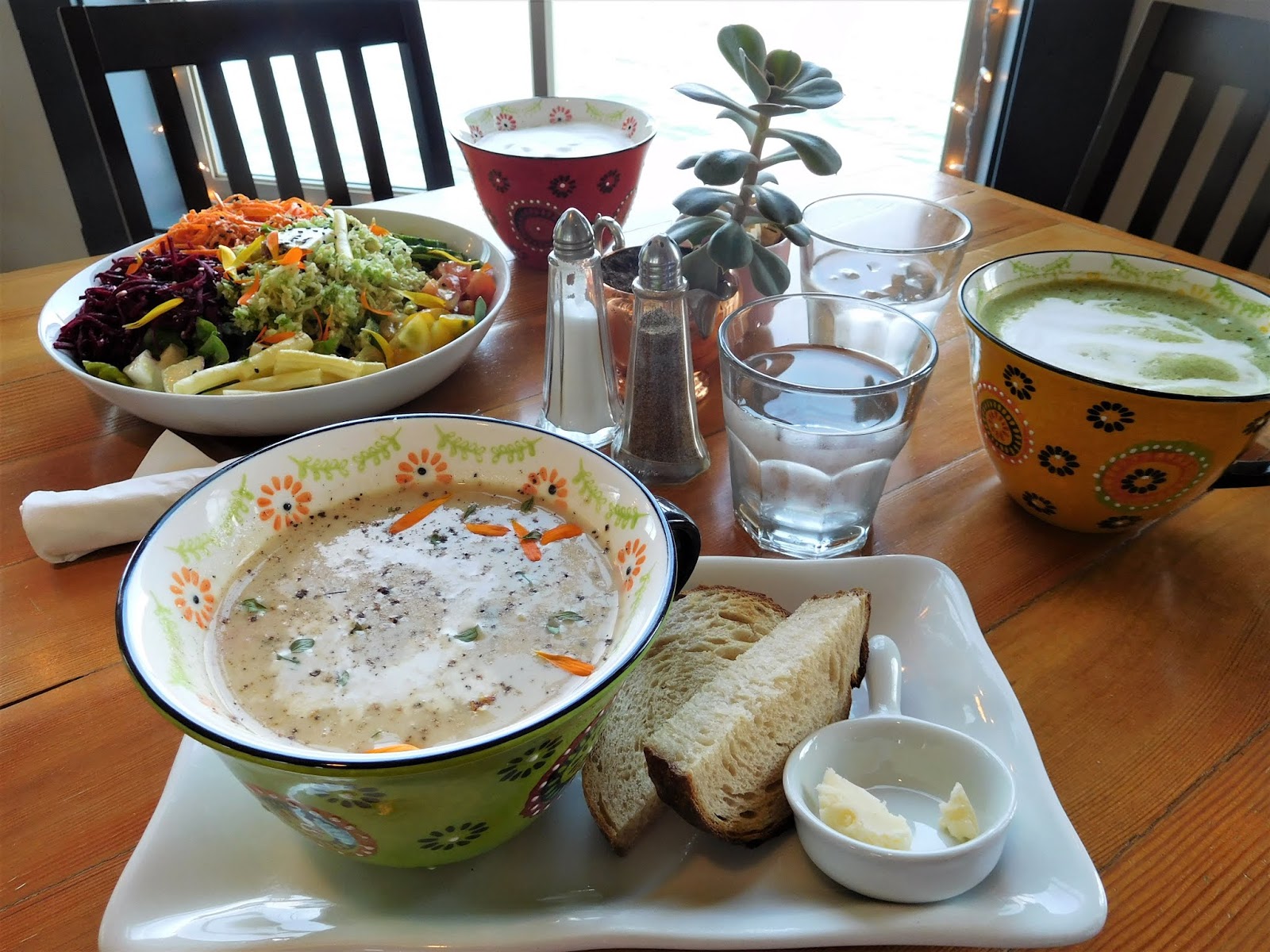
Gather Teahouse Eatery has a good working relationship with local farms, and there’s nothing better than the taste of fresh lettuce and vegetables from the garden.


We enjoyed the Galaxy Bowl, a wonderful combination of seasonal vegetables and greens with organic brown rice and a nutritional yeast vinaigrette dressing. We also had the Lightkeepers Seafood Chowder, a traditional 50’s recipe from those who lived and tended west coast lighthouse stations. It’s a grandfather’s recipe from the staff at Gather, and includes a cream base with pacific white shrimp, wild pacific cod, sole and local root vegetables; served with local artisan bread and butter, ooh so good.


For visitors arriving by boat, you can tie vessels on the outside of the wharf as space allows, or anchor out in settled weather. A guest buoy, suitable for boats up to 38 feet, is available while visiting Hope Bay.


From Hope Bay Public Wharf, we cruised up Navy Channel, passing through the Gulf Islands that spread themselves along the east coast of Vancouver Island. The Gulf Islands provide sheltered waters from the Strait of Georgia until the northern most island of Gabriola. This is also where boaters need to go through a choke point between the islands in order to continue northward. There are actually three choices (gates), all of which should be taken at slack water. The first and most common choice is through Dodd Narrows between Vancouver Island and Mudge Island. The second choice is to turn east and go through the gap (Gabriola Passage) between Valdes Island and Gabriola Island. This puts you out in the Strait of Georgia while motoring along the east side of Gabriola, until you are able to duck into Nanaimo harbour or continue north to other destinations along Vancouver Island.

Approaching False Narrows from the south

The third and least traveled gateway is through False Narrows between Mudge Island and Gabriola Island. While the current is half that of Dodd Narrows, the channel is very shallow with reefs; two sets of range markers help keep you in the deepest part of the channel. At first glance, the narrows look wide, but reefs are lying just under the surface of the water.

Heading towards the Range Markers

We had been wanting to go through this channel for several years, but found we didn’t have enough water depth when we stopped and looked in previous years. This year, the timing was good as we were at a 13 plus tide when reaching the entrance to False Narrows. Got d’ Fever has a draft of just under 5 feet, so our personal comfort level to transit False Narrows is on a 10 foot or better tide level.


False Narrows is heavily laden with kelp, which can tangle in your prop and/or get into the water intake for engine cooling. We found that being slightly just off the range makers kept us out of the worst patches of kelp.

Cute Cottages line the shores of False Narrows

We motored slowly through the channel, keeping an eye on the charts that show the route, and another eye on the range markers for the deepest channel; we soon made it through to the northern end near Dodd Narrows. We can now check False Narrows off our “done that list.”


Sunday, July 14, 2019

Three in One at Bedwell Harbour


Departing English Camp on San Juan Island, we crossed Haro Strait into Canadian waters and cleared customs in Sidney, B.C.  The following morning, we made our way to Bedwell Harbour on South Pender Island.

Bedwell Harbour consists of three distinct areas: Poets Cove Marina, Beaumont Park, and Medicine Beach.

Customs Dock at Poets Cove in Bedwell Harbour
Boaters coming from the States can clear customs at Poets Cove and treat themselves to a lovely stay at this quality resort.
Nice Dining and Lodging can be found at Poets Cove Marina & Resort

People of all ages have a great time at Poets Cove Resort

Poets Cove Marina & Resort offers nice dining venues, swimming pools, a fitness center, and upscale lodging with wonderful views. It’s a great place to relax over dinner or take in a spa treatment.

For those who enjoy the outdoors, the adjacent Beaumont Marine Park offers mooring buoys, walk-in camp sites ashore, picnic tables and trails. Fees for camping and mooring are collected May 15-Sept 30, payable at the self-registration payment box at the top of the stairs above the beach.


Anchorage and Mooring Buoys at Beaumont Marine Park
The area also offers good anchorage. A trail map is posted upland and shows two loop trails. You can opt for the shorter Beaumont Loop Trail, or the longer Mt. Norman Loop Trial with an elevation gain of 800 feet; the longer hike is rewarded with fabulous views, overlooking the harbour and beyond.

Trails at Beaumont Marine Park start at the head of the stairs

Most boaters are familiar with Poets Cove and neighboring Beaumont Park but may not be as familiar with Medicine Beach located across the harbour, northwest of Poets Cove.

Medicine Beach, across Bedwell Harbour, northwest of Poets Cove
Anchorage is available off Medicine Beach for either the mother ship or the dinghy, but be aware of the charted rocks and shoals. We chose to moor on a buoy at Beaumont Park and take the dinghy over to Medicine Beach.

Medicine Beach, Poets Cove in the far distance
We discovered a small convenience store, the Penderosa Pizza shop, and the cute Slow Coast Coffee shop located just a short walk up the road from the beach.

The Penderosa Pizza Shop above Medicine Beach

The Slow Coast Coffee shop above Medicine Beach
While Poets Cove is for pampering, Medicine Beach is folksy, and laid-back. We purchased an iced latte and were pleasantly entertained by a group of musicians, who were celebrating a friend’s birthday by putting on a jam session at the coffee shop; it was great fun and I couldn’t help but join in with a little singing of my own.


Hidden from view by the trees, one would never guess that a coffee shop and pizzeria could be found just up the steep, country road. Unfortunately, Medicine Beach is often passed up by boaters as they make their way through the channel or neck connecting North and South Pender Islands.

Medicine Beach seen from the trail above
Medicine Beach includes a 20-acre protected Nature Sanctuary that consists of a brackish marsh, coastal bluffs, and forested uplands.


The coastal bluff includes a short loop trail with nice views across the harbour. The Sanctuary is owned by the Islands Trust Fund and managed by the Pender Islands Conservation Association.


In earlier times, Medicine Beach was the location of summer camps for the WSANEC First Nations. Evidence found from archaeological digs near the channel between South and North Pender Islands indicates that the indigenous people have had a presence on the Penders for more than 5,000 years.


Boaters have three great areas to enjoy in Bedwell Harbour; a three in one stop with lots to see and do.

Friday, July 12, 2019

English Camp on San Juan Island


After our lunch stop at the Westcott Shellfish farm, we motored the dinghy around the corner into Garrison Bay, a popular anchorage for boaters visiting English Camp.


When the Pacific Northwest border between the U.S. and British territories were in dispute, San Juan Island was occupied by both American and British troops — American Camp on the south end of San Juan Island, and the British on the northwest side of the island. Both nations claimed ownership of the San Juan Islands, which nearly led to war at the beginning of this confrontation.


The Oregon Treaty in 1846 had set the 49th parallel as the boundary between the two nations, but the treaty was vague about which side of the San Juan Islands the boundary fell. Both British and Americans had settled on the island, establishing farms. A squabble over a pig in 1859 led to the exchange of threats (known as the Pig War), and both nations sent troops to set up camp on San Juan Island. After 12 years of peaceful joint military occupation, the issue was finally resolved. Over the years, the opposing camps developed friendly relationships, including joint dinners, socials, and sporting events. Some of the buildings at English Camp still remain, and visitors can walk the grounds and read the informative placards.


The English had it more comfortable than the Americans. Unlike the American Camp, where improvements were regularly denied, English Camp was well supported and had the advantage of being financed by the colonial government on Vancouver Island.


In 1867 a vegetable garden was established, which later became a formal garden for the commander’s wife. The gardens also served as a natural dividing line between the officers, who lived on the hill above, from the troops who lived in the barracks near the blockhouse below the hill.

Today, boaters can bring their dinghy ashore and tie-up at the park dock. The visitor center, located in one of the barracks, is open seasonally from 9 a.m. to 5 p.m.; the grounds are open till dusk.


A trail connects English Camp with Westcott Bay Shellfish farm, a nice option to see both sites for those who enjoy hiking.

A trail leads from Westcott Shellfish farm to English Camp at Garrison Bay


Westcott Bay Shellfish Farm


After our stop at Yellow Island, we continued around the north end of San Juan Island and anchored in Westcott Bay on the northwest side. Westcott Bay is home to the Westcott Bay Shellfish farm, where boaters can arrive by dinghy to visit the farm. Westcott Bay has plenty of room to anchor the mother ship, or you can anchor in nearby Garrison Bay. We have found that Westcott Bay is less crowded, has more space to anchor, and offers good anchoring depths.


Boaters are welcome to tie dinghies (bow-tie only) at the designated dinghy dock to visit the oyster farm, while purchasing shellfish or enjoying their oyster barbecue. The onsite store carries bread, cheeses, and drinks, including beer and ciders, to accompany the fresh oysters served with a choice of tasty sauces.
Select your fresh shellfish; farm staff can show you how to shuck oysters
Westcott Bay Shellfish Co. is a working agriculture farm, but staff will show you how to shuck oysters as time allows. You can take the oysters, mussels, and clams back to your boat to prepare your meal, or place an order for barbecued oysters off their grill and enjoy a lunch at one of their picnic tables overlooking the bay.

Oysters off the grill served with tasty sauces
The farm is open to the public 11 a.m. to 5 p.m. six days a week (closed on Tuesdays) during the summer months. You can now visit during the off-season on Saturdays. Erik and Andrea Anderson purchased the farm in 2013 and brought the property back to life, restoring its legacy as a quality oyster farm. 


In the late 1970’s the farm was widely known for its oysters, which appeared on menus around the country. The farm declined over the years and was put up for sale as a home site. Thanks to the efforts of Erik and Andrea, this oyster farm has been returned to its former glory.


The depleted shellfish crops were replanted and the farm infrastructure replaced. The purchase and preservation of this property would not have been possible without the support of the San Juan Preservation Trust.

It’s not often that boaters have the opportunity to visit an oyster farm and see its operation first-hand, while enjoying fresh oysters off the grill; this is truly a unique experience not to be missed.


A beautiful sunset at Westcott Bay

Yellow Island


There are many special places to stop in the San Juan Islands that are outside the ferry route and accessible only be private boat, kayak or dinghy. Yellow Island, part of the Wasp Island Group, is one of those special islands, which was purchased by the Nature Conservancy to preserve the diversity of native plants, flowers, and grass lands. A variety of bird species frequent the island.


The Conservancy carries out ecological research year-round on the Island and visitors are asked to stay on the designated trail. Access is by small craft, such as dinghies and kayaks. Visitors can come ashore at the southeast side of the Island, on the beach below the wooden Dodd cabin. Anchor the mother ship on the northeast side of Yellow Island, or stay at nearby Deer Harbor Marina for easy dinghy access in settled weather. Visiting hours at Yellow Island are 10 a.m. to 4 p.m.; there’s no overnighting or picnicking due to the sensitive area and wildlife.


Lew and Elizabeth Dodd lived on Orcas Island in the 1930's, where they raised their two girls. Then around 1945, they moved to start a homestead on Yellow Island and built a cabin between 1945-1947 with $200 worth of nails, windows from their previous chicken coop, and a few logs which they floated over from their property on Orcas. Other building materials consisted of salvaged driftwood, stones, and materials from decommissioned boats. Today, the cabin remains basically unaltered and is now the full-time residence of the Island's caretaker. The cabin on the west side of the island on Breezy Point was built later as guest accommodations for their daughters and growing number of grandchildren. The extended Dodd family sold Yellow Island in 1979 to The Nature Conservancy to preserve this special 11-acre island, which their parents so dearly loved.

Thursday, July 11, 2019

Return to the Pacific Northwest


From Toulouse France, we flew home via Frankfurt, Germany then on to Calgary, Canada to fly across the country to Vancouver B.C. and then drove our car across the border back home to Anacortes. It took several days for our bodies to adjust its internal clock and feel rested again. After taking care of business at home and repacking the boat, we were off for destinations northward in the Pacific Northwest, the best cruising ground in the world.


We departed Anacortes in the afternoon of July 11th and stopped at Shoal Bay on the north end of Lopez Island. This large bay provides ample room for many boats, with a flat bottom consisting of depths ranging from 18-30 feet. A private marina is located in the bay and boaters will find a number of crab pots during the season.
We found it amusing that, despite all the room to anchor, a small boat came into the bay and anchored right in front of us; so close that we hoped they hadn’t dropped their anchor on top of our anchor. It's human nature to want to be near others, but some boaters tend to forget that the anchor is located a fair distance from the front of a boat. Boats also need room to swing if the wind comes up. Thankfully, we had no problem raising the anchor when we departed the following morning.